Publications
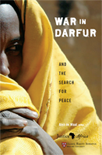
War in Dafur and the Search for Peace
Alex de Waal (editor), 2007
A new book from Justice Africa, edited by Alex de Waal. Due to be published in July 2007. For further details contact ja@justiceafrica.org or see Harvard University Press
Since 2003, the Darfur region of Sudan has been the locus of a hideous war that has aroused the outrage of millions of ordinary people across the world. But despite a high level of media coverage and activist mobilization, Darfur’s society and politics remain poorly understood. War in Darfur and the Search for Peace brings together essays by noted Sudanese scholars and international experts on Darfur, containing much new historical and contemporary research. The first part of the volume examines the causes of the war, including chapters on how the Sudanese state functions, how disputes over land rights and local government helped spark conflict, the origins and development of the infamous Janjawiid militia and the rebel movements, and how Darfur’s war is entangled in the ongoing political crisis in Chad. The second part turns to the international efforts to achieve peace in Darfur. Three chapters, written by participants in the African Union’s mediation effort, document and analyze the attempt to mediate between Khartoum and the rebels. Contributions also examine how Darfur has been represented in the American press and how it has been the basis for an enormous advocacy campaign.
Darfur, A short history of a long war
Julie Flint and Alex de Waal, 2005
Sudan’s westernmost region, Darfur, sprang from oblivion into sudden notoriety early in 2004, when a war of hideous proportions unleashed what the United Nations called ‘the world’s worst humanitarian crisis’ and the United States labelled ‘genocide’. For the last two years, the conflict has been simplified to pictures of immense sprawling refugee camps and lurid accounts of ‘Arabs’ murdering ‘Africans’.
Behind these images lies a complex and fascinating story of a remarkable and remote region of Africa, home to Muslim peoples with a unique history. In the 20th century, Darfur became synonymous with poverty and neglect, culminating in famine and a series of undeclared and unacknowledged wars in the 1980s and 1990s. This book details the history of Darfur, its conflicts, and the designs on the region by the governments in Khartoum and Tripoli.
Much of the story of the war in Darfur has remained untold until now. This book investigates the identity of the infamous ‘Janjawiid’ militia, tracing its origins, organization and ideology. It inquires into the nature of the insurrection launched by two rebel groups, the radical Sudan Liberation Army and the more Islamist-oriented Justice and Equality Movement. It charts the unfolding crisis and the confused international response, including the African Union’s first major venture into peacemaking and peacekeeping. The book concludes by asking what the future holds in store for Darfur.
See a joint review of Darfur: A Short History of a Long War, and Darfur: The Ambiguous Genocide by Gérard Prunier, in the New York Review of Books
This publication can be ordered from www.zedbooks.co.uk
Famine that Kills; Darfur, Sudan
Alex de Waal
In 2004, Darfur, Sudan was described as the “world’s greatest humanitarian crisis.” Twenty years previously, Darfur was also the site of a disastrous famine. Famine that Kills is a seminal account of that famine, and a social history of the region. In a new preface prepared for this revised edition, Alex de Waal analyzes the roots of the current conflict in land disputes, social disruption and impoverishment. Despite vast changes in the nature of famines and in the capacity of response, de Waal’s original challenge to humanitarian theory and practice including a focus on the survival strategies of rural people has never been more relevant. Documenting the resilience of the people who suffered, it explains why many fewer died than had been predicted by outsiders. It is also a path breaking study of the causes of famine deaths, showing how outbreaks of infectious disease killed more people than starvation. Now a classic in the field, Famine that Kills provides critical background and lessons of past intervention for a region that finds itself in another moment of humanitarian tragedy.
Who Fights? Who Cares? Who and Humanitarian Action in Africa
Alex de Waal
Africa faces huge political and humanitarian challenges. Sixteen countries are stricken by war or serious instability; the shadow of genocide looms over central Africa; while natural and man-made disasters threaten the lives and livelihoods of millions of Africans. International structures for peace and security and the delivery of humanitarian assistance have so far failed to prevent enduring crisis across the continent. Hopes of new models for ‘African solutions to African problems’ have suffered severe setbacks in the last few years.
The essays in this collection address this range of challenges:
* Why war persists in Africa – is the continent caught in a ‘war trap’ whereby conflict is generating more conflict?
* What are the causes, implications and solutions for genocide, especially in the Great Lakes?
* What structures for regional peace and security are required for an effective international security order in Africa?
* What is the future of humanitarian intervention in Africa – and in particular, do African forces now require a specifically African doctrine for intervention?
* Certain forms of democratic political process can help prevent famine – how can these be made a reality in Africa?
* What institutions and capacities can be effective in preventing and relieving humanitarian crises?
* What is the role for international humanitarian law – is it an irrelevance, or is it central to any effective response to humanitarian crises?
* What mechanisms for humanitarian accountability can be developed?
The Phoenix State: Civil Society and the Future of Sudan
A. H. Abdel Salam, Alex de Waal
Sometime in the coming months and years, Sudan will face a transition to peace and democracy. This will be time of immense opportunity for the country: how will it respond to the enormous challenges of building a society based on equality, democracy and human rights?
This book represents the efforts of Sudanese civil society organizations to come to terms with these challenges. Each chapter deals with a basic issue for the future of sudan. some of the basic questions addressed include:
* How is sudan to develop a constitution that guarantees the rights of its citizens, overcoming the problems of division, inequality and militarism in the country?
* How is free expression and religious equality to be guaranteed, ina country scarred by religious extremism and bigtory?
* Women in Sudan have long suffered oppression and discrimination. What is the agenda for women’s emancipation?
* How is self-determination to be implemented so that the Southern sudanese can achieve their rights? What constitutional framework is appropriate for Southern Sudan?
* How are the rights of ethnic minorities in Northern Sudan to be guaranteed? What race relations laws are needed?
* What form of accountability for past human rights abuses should there be? Should there be prosecution and punishment, a truth commission, or should bygones be bygones?
* What judicial reforms will be necessary so that the law in sudan can serve the people, and no longer be an insturment of division and repression?
